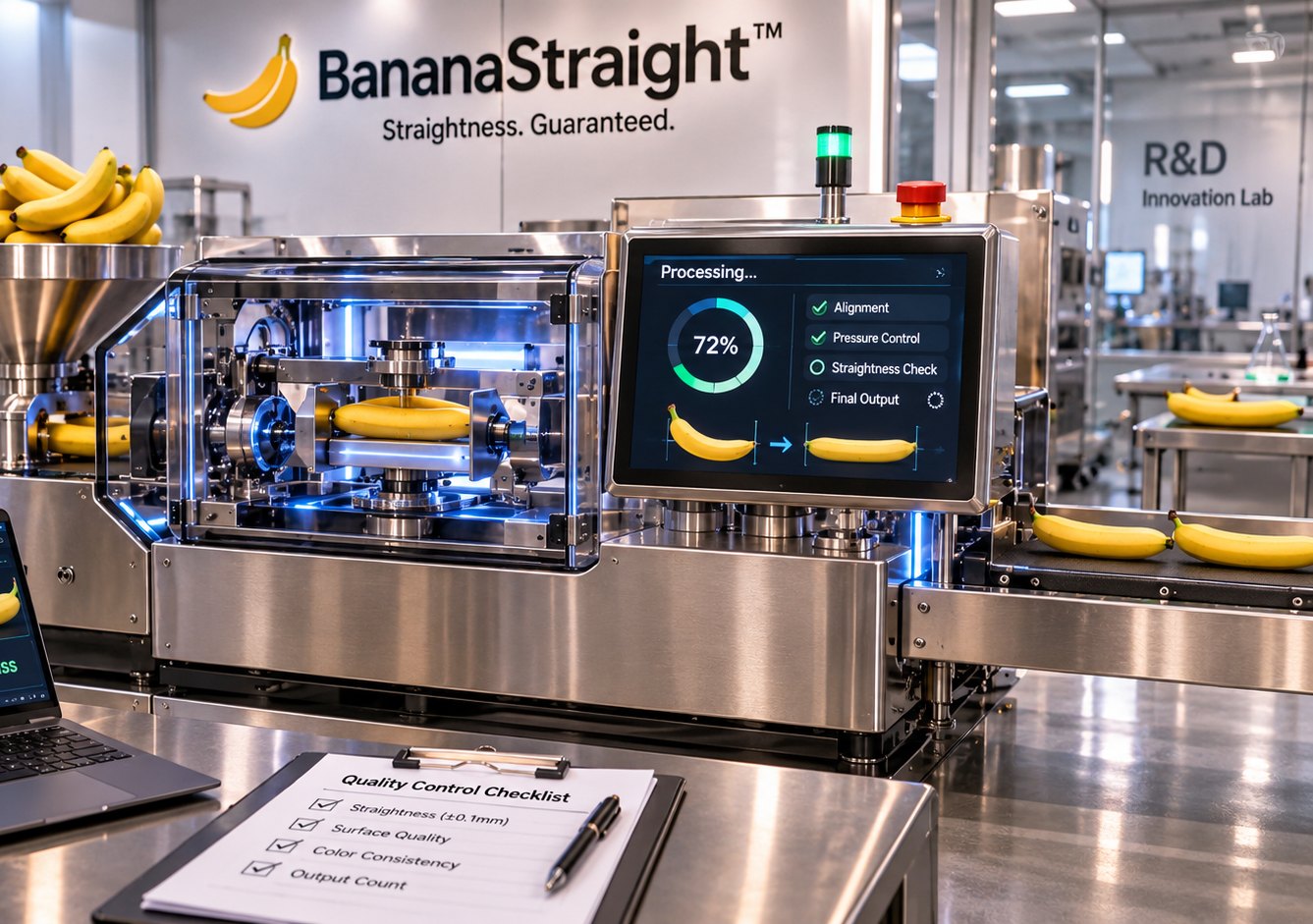
The Meridian cell.
Seventh generation, designed and built in our own works. It straightens one banana at a time and has never been sold or licensed.
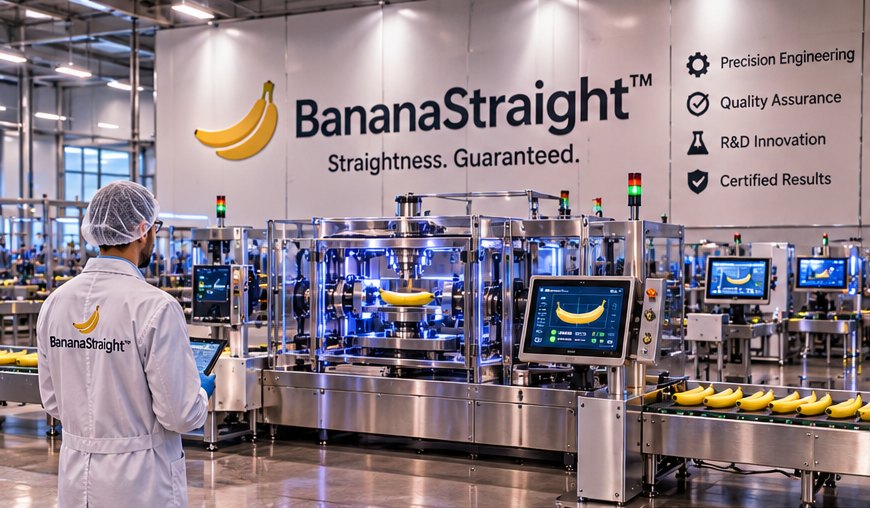
It listens more than it presses.
The first BananaStraight machine, in 1987, was a jig and a patient man. It took forty minutes and split one fruit in three. The lesson from those years still governs the design: a banana straightens when it is ready, and the machine's job is to notice.
A Meridian cell spends nine of its eleven minutes measuring. Force is applied in steps of four micrometres and withdrawn the moment the peel's response departs from the model.
Four systems in one cell
Ridge mapping
Structured blue light records the dorsal ridge at 2,400 points. Girth, taper and peel thickness are read in the same pass.
Path planning
The controller solves a correction path for that fruit alone. It decides the order of contact, the support points and the dwell at each step.
Adaptive platens
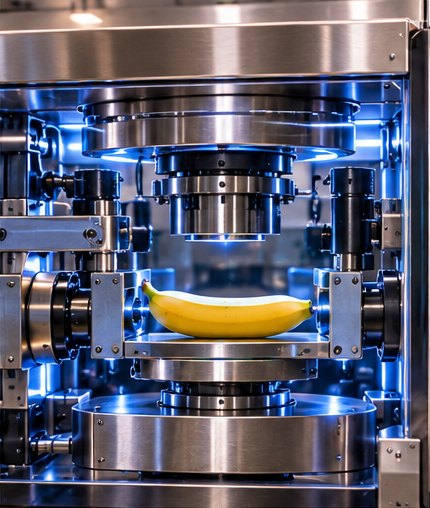
Two platens of polished 316L steel, each with 64 independently driven segments. Peak pressure never exceeds 0.8 newtons per square centimetre.
Closed-loop release
The platens open in stages while the fruit is watched for spring-back. If it moves, the cell closes and continues.
Specification
| Cycle time | 11 min 04 s |
| Correction steps | 340 |
| Step resolution | 4 µm |
| Peak platen pressure | 0.8 N/cm² |
| Sensor sampling | 600 Hz |
| Cell temperature | 13.2 °C ± 0.1 |
| Finished tolerance | ≤ 0.1 mm |
| Cells in service | 252 |
| Fruit per cell per day | 118 |
Figures for Meridian 7, in service since 2023.
Research
Four hundred and sixty people work in research, most of them in Rotterdam. Current programmes include peel rheology at low strain rates, a non-contact verification method using interferometry, and a long study of whether straightness can be bred. After thirty years, the answer remains no.
We file few patents. The Meridian cell is protected mainly by being very difficult to build.