Fourteen months, nine stages, one line.
Every banana we release can be traced back through each of these steps to a single plant on a single slope. This is the whole of it.
Stage 1 of 9. Estate
We start with the ground.
A banana that grew fighting for light has already decided its shape. Our estates are planted on east-facing slopes between 80 and 300 metres, at a spacing wide enough that no plant leans for the sun. We do not buy fruit on the open market and never have.
- Estates
- 14, all owned
- Planted area
- 9,600 hectares
- Spacing
- 2.4 m on a square grid
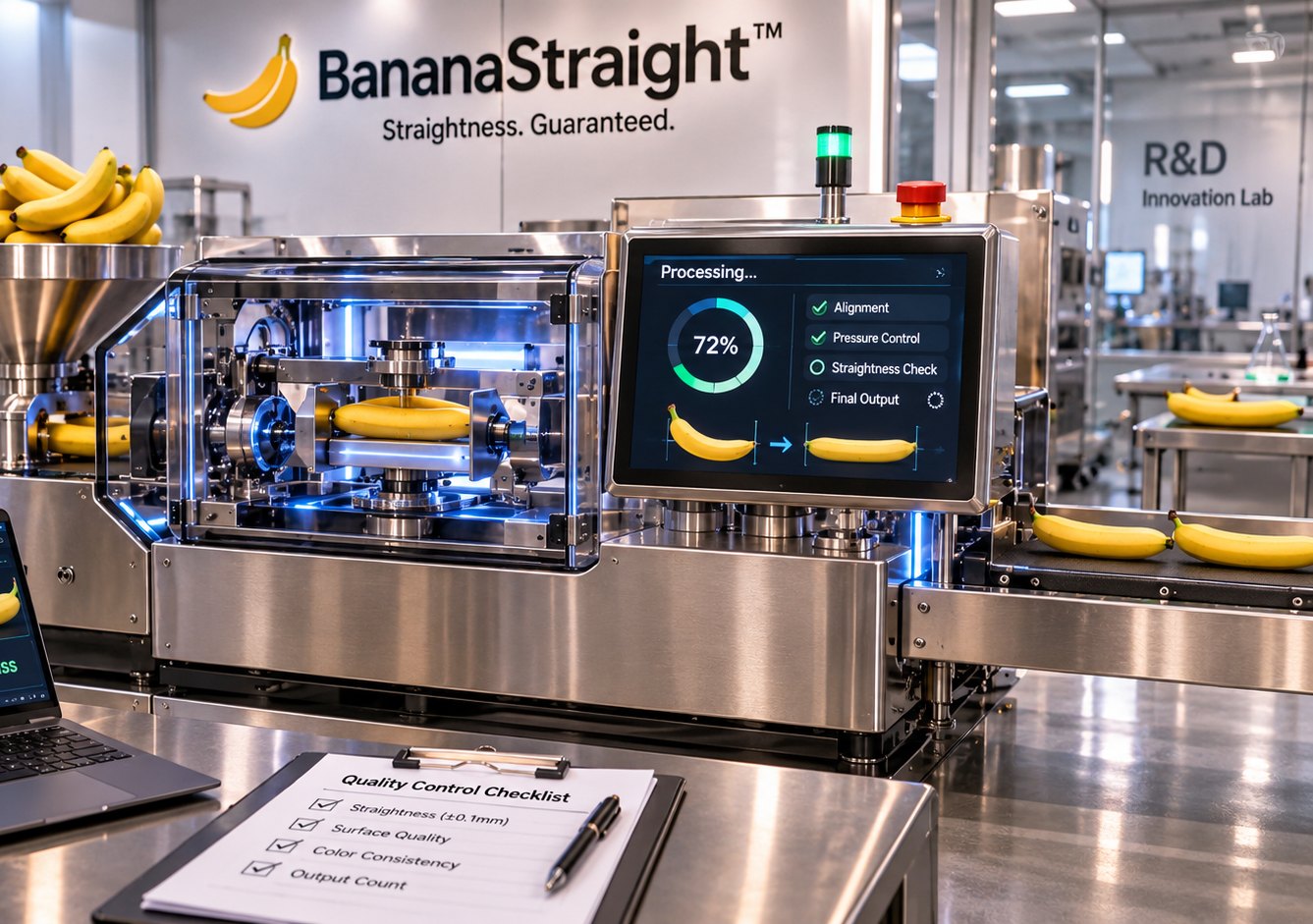
Stage 2 of 9. Planting
Every plant has a known parent.
All BananaStraight fruit descends from 212 mother plants chosen over thirty years for long, even fingers and a low natural sagitta. Plantlets are raised from tissue culture in our own laboratory and tagged before they leave it. The tag stays with the fruit to the client's door.
- Mother plants
- 212 in the register
- Time to first bunch
- 11 to 14 months
- Traceability
- Plant, hand and finger
Stage 3 of 9. Bunch selection
Thirty-nine refusals for each acceptance.
Selectors assess each hand on the plant, nine weeks after flowering. They look at finger length, girth, taper and the evenness of the arc. A banana with a kink cannot be corrected; a banana with a clean, regular curve can. Only the second kind is tagged for harvest.
- Selectors
- 640, each certified annually
- Entry length
- 190 to 205 mm
- Acceptance
- 2.5 percent of fingers
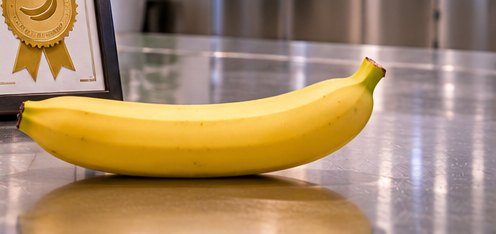
Stage 4 of 9. Harvest
Cut by hand, carried, never dropped.
Tagged fingers are cut individually in the first two hours of light, when the peel is coolest and most elastic. Each goes into a moulded cradle that travels with it by cableway to the packing station. Fruit and ground do not meet.
- Cutting window
- 05:30 to 07:30
- Handling
- Individual cradles
- Transit to cold dock
- Under 40 minutes
Stage 5 of 9. Conditioning
Three days learning to yield.
A banana corrected cold will split. One corrected warm will bruise. For 72 hours the fruit rests at 13.2 degrees and 91 percent humidity, the narrow window in which the peel fibres become compliant without the pulp beginning to ripen.
- Temperature
- 13.2 °C, held to 0.1
- Humidity
- 91 percent
- Duration
- 72 hours
Stage 6 of 9. Alignment
First we learn the curve exactly.
Before any pressure is applied, structured light maps 2,400 points along the dorsal ridge. The cell computes a correction path unique to that fruit: where to support, where to press, how far, and in what order. No two bananas receive the same programme.
- Points mapped
- 2,400 per fruit
- Positioning accuracy
- 0.01 mm
- Programme
- Unique to each fruit
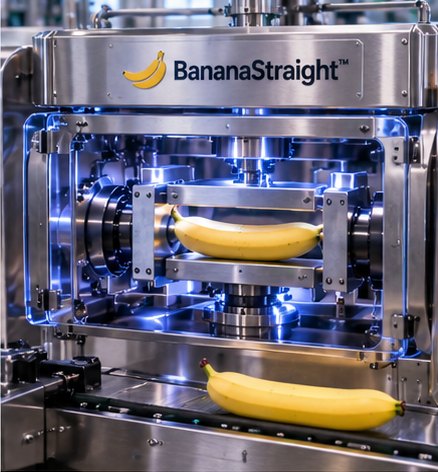
Stage 7 of 9. Straightening
Eleven minutes, less pressure than a resting hand.
The platens close in 340 small steps. Between each step the cell pauses, measures the fruit's response and adjusts. If the peel resists, the cell waits. The cycle ends when the fruit holds true with the platens open, and not before.
- Cycle
- 11 minutes, 340 steps
- Peak pressure
- 0.8 N per cm²
- Sampling
- 600 readings a second
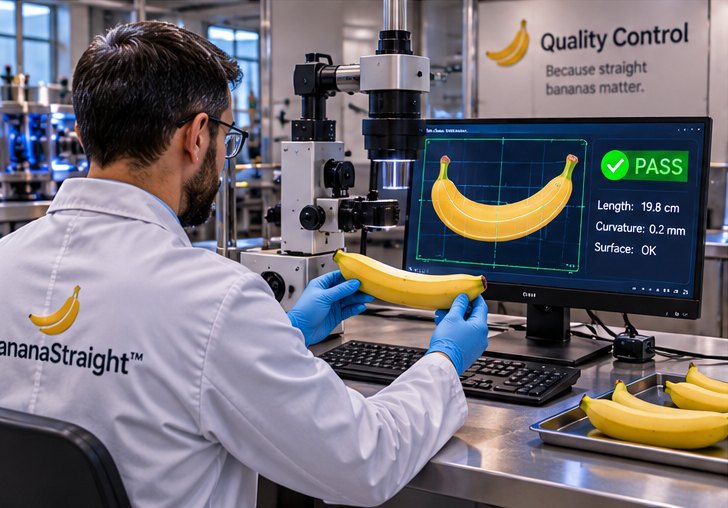
Stage 8 of 9. Verification
Measured twice, by machine and by hand.
Each fruit rests for six hours and is measured again, because a banana that has only been persuaded will try to return. Those that hold within 0.1 mm receive a dimensional certificate. Those that do not are sent to our juice partner, whole and unmarked.
- Rest before measuring
- 6 hours
- Tolerance
- 0.1 mm over full length
- Pass rate at this stage
- 94 percent
Stage 9 of 9. Release and shipment
Twelve to a case, none touching.
Verified fruit is packed in rigid cradles, twelve to a case, and released against the month's allocation. It travels at conditioning temperature and is logged every ninety seconds. Clients ripen it on arrival, following a schedule supplied with each lot.
- Case
- 12 fruit, rigid cradle
- Transit temperature
- 13.2 °C
- Typical door to door
- 9 to 16 days